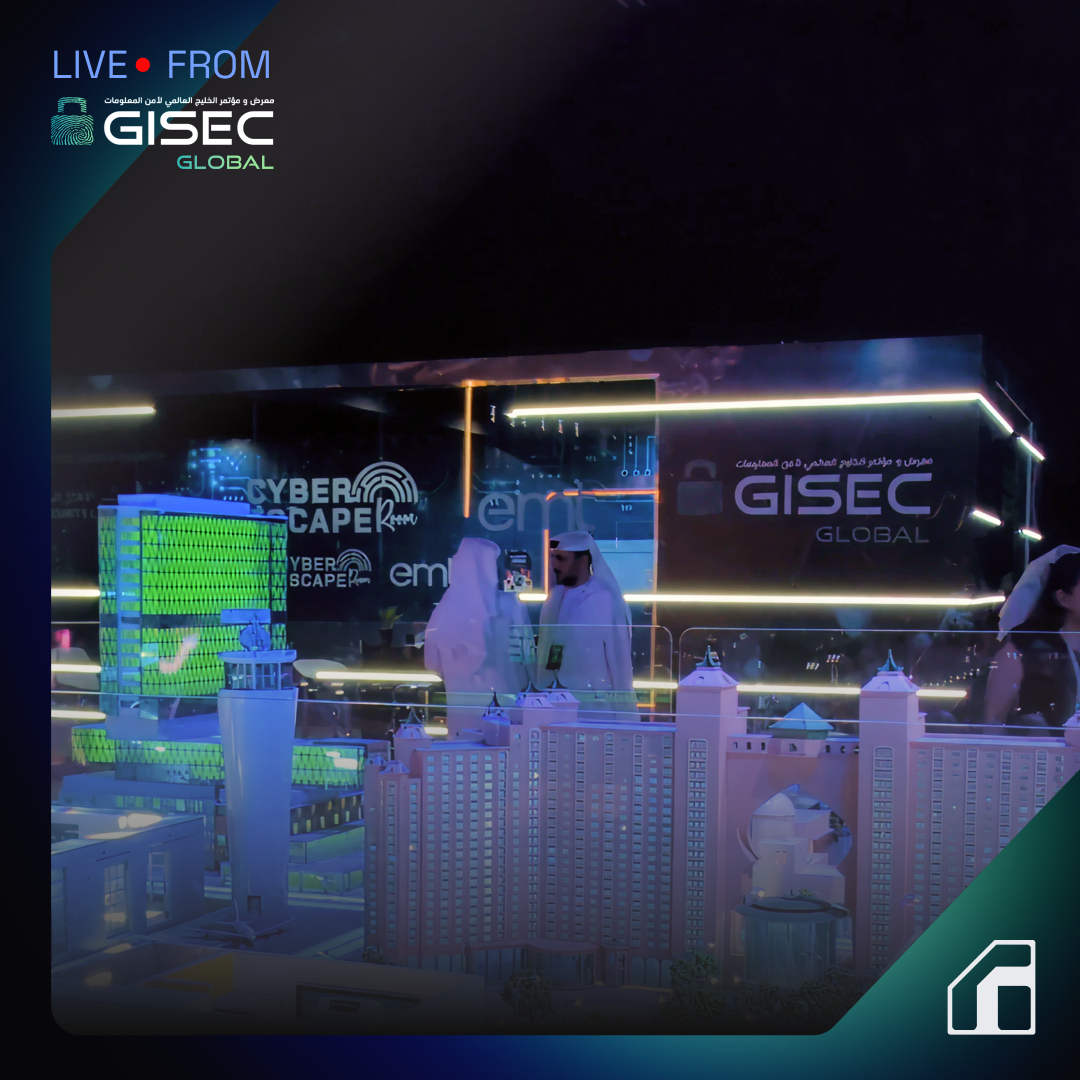
GISEC Global 2025, held May 6–8 at the Dubai World Trade Centre, assembled cybersecurity leaders from over 130 countries. With 500+ exhibitors and a projected market reaching $298.5 billion by 2026, the conference underscored the Middle East's expanding role in shaping global cyber strategy.
What set this year apart: cybersecurity wasn't presented as a product. It was framed as infrastructure. The floor wasn't full of theoretical demonstrations. It was full of nation-scale deployments and real AI integrations already in production.
"Cybersecurity has become not only an integral part of everything we do, but also a core pillar of our leadership vision."
— H.E. Dr. Mohamed Al Kuwaiti, keynote address
Dr. Al Kuwaiti cited 200,000+ cyberattacks daily against the UAE, framing security not as a strategy but as an operational necessity.
Three Signals That Defined the Conference
1. AI as Battlefield Advantage
AI moved from theoretical to operational at GISEC 2025. Microsoft's Agentic AI demonstrations showed real-time threat hunting across hybrid environments with minimal human oversight. The message was clear: organizations that embed AI as infrastructure — not novelty — will outpace those still evaluating it.
Rilian's CaspianAI™ is built for exactly this context: autonomous execution in sovereign environments where human-speed response is no longer sufficient.
2. Operational Technology as Primary Focus
Unlike global conferences that prioritize cloud and IT endpoints, GISEC 2025 centered on physical infrastructure: oil, water, energy, transportation. Deception technology in OT environments emerged as critical for detecting lateral movement in industrial control systems. For the Gulf, OT security isn't peripheral — it's existential.
3. Deployment as Differentiator
Real-world operational capability replaced theoretical roadmaps as the evaluation standard. The UAE's National Information Assurance Platform signaled movement toward automated compliance monitoring. Solutions that demonstrate performance under actual conditions — not concept demonstrations — earned the room.
Emerging Signals Worth Watching
- Post-quantum cryptography adoption timelines moving from research to policy
- Digital twin modeling for stress-testing scenarios without destabilizing live systems
- Human-machine orchestration across agents, sensors, and operators
- AI governance frameworks integrated into infrastructure design
- Cross-border collaboration through the Crystal Ball Initiative (150+ countries)
What Rilian Showcased
Rilian demonstrated four core capabilities at GISEC 2025:
- Marketplace: Enables sovereign procurement without architectural lock-in, restoring buyer control
- DawnTreader™: Delivers real-time compliance automation and coordinated response across national infrastructures
- CaspianAI™: Operates as a decision layer in live environments with local governance and instant execution
- Unified Defense Platform (UDP): Complete telemetry coordination across OT, IT, cloud, and identity systems — 100% visibility, reduced attack surface
Rilian also previewed AI agent training capabilities developed collaboratively with CPX.
The Bottom Line
GISEC 2025 was proof under operational load. Dr. Al Kuwaiti's vision of "cyber as embedded infrastructure" isn't aspirational anymore — it's executing. The Gulf isn't theorizing sovereign cyber defense at national scale. It's building it.