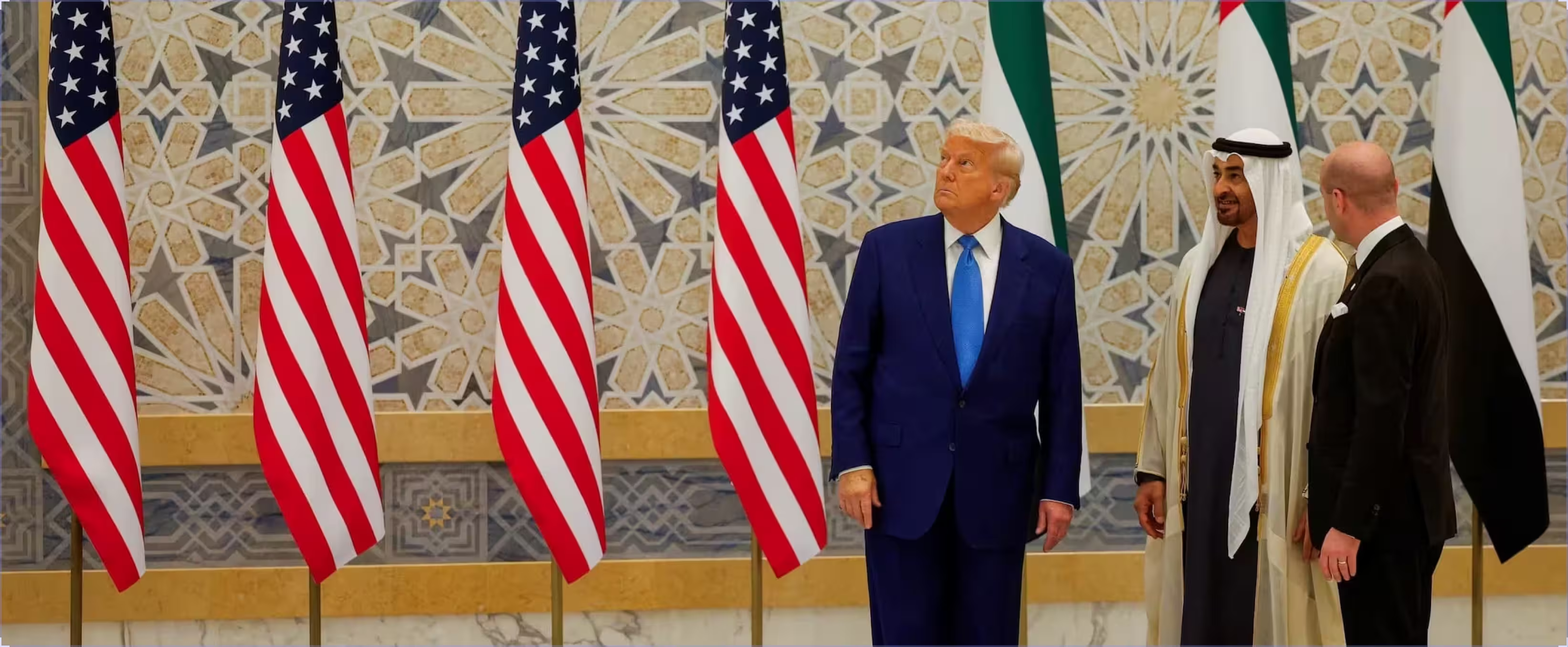
This isn't diplomacy. It's a joint architecture of defense.
President Trump's visit to the Middle East, from May 13th to May 16th 2025, didn't just reaffirm the current U.S. administration's engagement with the GCC — it confirmed a global pivot that cyber operators have seen coming for years. The Gulf is no longer a buyer of innovation. It's a builder of infrastructure.
These cyber and AI deals go beyond exports. They signal a regional shift toward sovereign co-architecture. The U.S. remains the strategic driver of global cyber innovation, but today, a key strength lies in operationalizing that innovation with allies who can move fast, deploy widely, and design for resilience from the start.
The Gulf Is Building, Not Buying
The Abraham Accords marked a historic shift in regional cooperation, laying the groundwork for today's operational alignment between Gulf nations and the U.S. What began as diplomatic normalization is now evolving into fast-growing technology partnerships — including creating cyber infrastructure and architecture.
During his visit to the UAE in May 2025, President Trump announced $200 billion in new bilateral agreements and confirmed the acceleration of $1.4 trillion in previously committed UAE investment. Days later, the White House confirmed another $600 billion investment package from Saudi Arabia, spanning defense and digital infrastructure.
These agreements signal a shift toward co-developed platforms built to meet national requirements on local infrastructure, with local control. U.S. firms are no longer just shipping tools — they're integrating into Gulf frameworks shaped by local regulators, security demands, and data mandates.
"The first Trump Administration's diplomatic and economic achievements — such as the Abraham Accords — laid the initial foundation for these developments. Today, these states present tremendous opportunities for U.S. partnerships based on shared priorities for security and prosperity, both regionally and globally. The U.S. brings leading innovation expertise and global security insights, particularly in AI and cybersecurity. The Gulf contributes sovereign commitment, conflict-zone urgency, and formidable financial resources."
— Christian Schnedler, CEO, Rilian Technologies
From Strategy to Architecture
The UAE isn't waiting to adapt to the future. GISEC 2025 confirmed what's now unfolding at scale: the Gulf isn't experimenting — it's executing. In the week following the event, U.S.–GCC cooperation moved from agreements to deployments, with new initiatives focused on sovereign cloud, real-time threat systems, and national AI infrastructure.
U.S. and Gulf States Are in Alignment
What's unfolding between the U.S. and the Gulf isn't a distribution of influence — it's the co-design of infrastructure that reflects both urgency and depth.
The U.S. brings:
- Strategic Doctrine: proven frameworks for defense, deterrence, and layered cyber architecture
- AI Research Leadership: advanced model training, red-teaming, and trust-layer engineering
- Global Intelligence Networks: threat visibility across borders, sectors, and adversarial ecosystems
- Interoperability Standards: system architectures built to scale across government, military, and industry
The Gulf brings:
- Operational Urgency: frontline proximity to regional conflicts, state-sponsored attacks, and information warfare
- Sovereign Capital: government-backed resources deployed with speed and clarity
- Execution Mandate: the authority to build at national scale
Key Deployments Driving the Shift
- AI Campus — Announced in May 2025 as the largest outside the U.S., designed to train sovereign LLMs and model kinetic-cyber fusion scenarios
- Nvidia Chip Pipeline — Agreement to import 500,000 H100s annually to power national-scale AI deployments for threat detection and response optimization
- AWS Sovereign Launchpad — Hyperscale cloud infrastructure built specifically for government workloads, with zero foreign dependency
- Google Cybersecurity Center — National node for cybercrime forecasting, breach cost modeling, and SOC enablement at state level
- Counter Ransomware Initiative + Crystal Ball Platform — Real-time visibility between allied states
Execution in Sync
The Gulf's priorities are already reshaping the global cyber landscape. The U.S. administration's visit accelerates a new cyber order: governments, cloud providers, chipmakers, and cyber firms working in sync to harden national infrastructure.
At Rilian, we don't just support that shift — we help build it. We work alongside national teams to deploy sovereign-grade systems that don't just respond to threats, but stand ready before they arrive.